
Operations
Business Efficiency
Growth Systems
Automations
Less friction, more control

Maximiliano Chereza
28 February 2026
3 min read
Connected tools and clear workflows reduce noise, simplify work, and build confidence in how your business runs.
Less friction is usually the real goal
Most teams do not set out to build messy operations. It just happens over time, as new tools get added and work evolves faster than the systems that support it.
If you want more operational control, start by looking for friction, not failure. The everyday friction is where your time, confidence, and visibility quietly disappear.
The noise you feel is often structural
When tools do not talk to each other, people become the connection. They copy, paste, re-enter, double-check, and chase context across tabs and inboxes.
That creates a low-level hum of uncertainty. Even when things "work", it takes more effort than it should.
Control is not the same as oversight
It is tempting to respond by adding another tool, another check, or another layer of approval. That can make things feel safer in the short term, but it often adds more steps, more handovers, and more confusion.
Real control feels calmer. It comes from being able to trust what you are looking at and knowing what happens next without needing a meeting.
Where friction actually shows up
Friction hides in small moments that happen all day. They are easy to tolerate individually, but expensive in total.
Common signs include:
- the same information is being entered in multiple places
- status living in people's heads rather than in the system
- work stalling at handovers because the "next step" is unclear
- reporting that has to be rebuilt manually to feel accurate
If any of these sound familiar, you are not alone. They are normal symptoms of growth without aligned workflows.
What connected tools really change
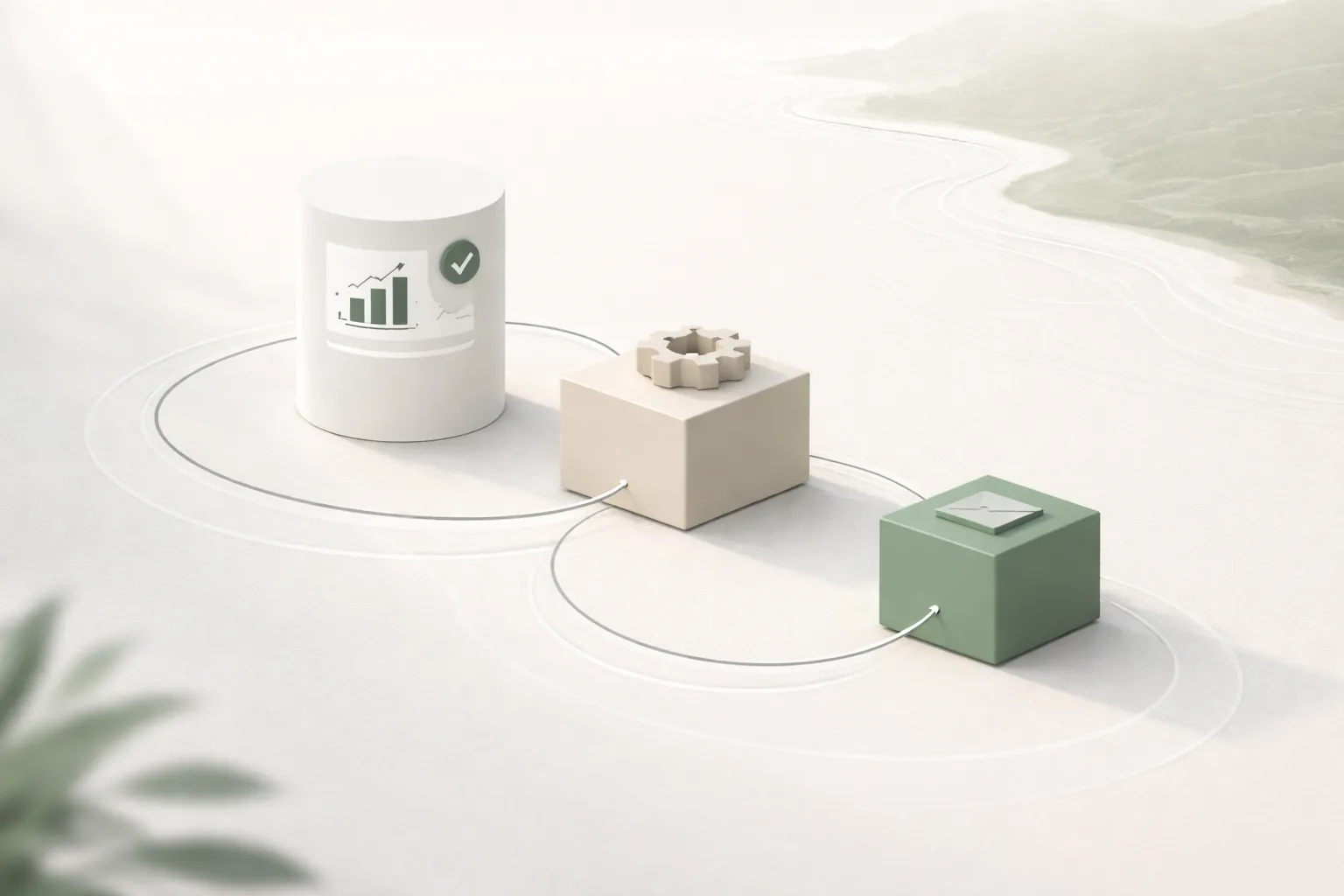
Connected tools are not about having everything in one platform. They are about information moving reliably, so work does not rely on memory or detective work.
When your tools are connected, duplication drops. Errors are reduced because the same source of truth flows through the process rather than being recreated each time.
You also get cleaner operational visibility. Not perfect dashboards for their own sake, but a clearer line of sight across what matters.
Workflow clarity is a design choice
Clear workflows are rarely the result of a single "big fix". They usually come from deciding how work should move, then shaping systems to support that reality.
A useful test is this: can a capable person follow the process without needing tribal knowledge? If the answer is "not really", the workflow is carrying hidden risk.
Clarity also protects quality. When steps are consistent, outcomes are steadier, and the business feels less reactive.
Operational control should feel lighter, not heavier
If your systems only improve control by adding admin, they are not doing their job. The point is to reduce operational drag, so your team has more headspace for the work that actually moves the business forward.
Sometimes that means improving how existing tools work together. Sometimes it means building a simple internal view that reflects how the business really runs.
Either way, the direction is the same: fewer manual bridges, fewer repeated questions, and more confidence in what is true.
A practical starting point
Pick one workflow that is frequent and slightly painful. Track it from start to finish and notice where friction appears.
Look for the moments where:
- someone re-keys information
- someone has to "check three places" to confirm status
- progress relies on chasing an approval or update
- an exception creates a scramble
You do not need to fix everything at once. You need to make one part of the system easier to trust.
What this looks like when Kurī Studio helps
Kurī Studio supports ambitious, established businesses by improving the underlying structure, not by piling on complexity. That often includes connecting internal tools, reducing manual handling, and creating workflows that are clearer to follow day to day.
The goal is steady: reduce friction, improve visibility, and help your systems better reflect the standard of your work.
"
Find the friction that’s costing you time
If your tools feel noisy or your team spends too much energy bridging gaps, we can help you map what’s really happening, identify the biggest friction points, and outline a calm, practical path to better visibility and control.
Book a short call