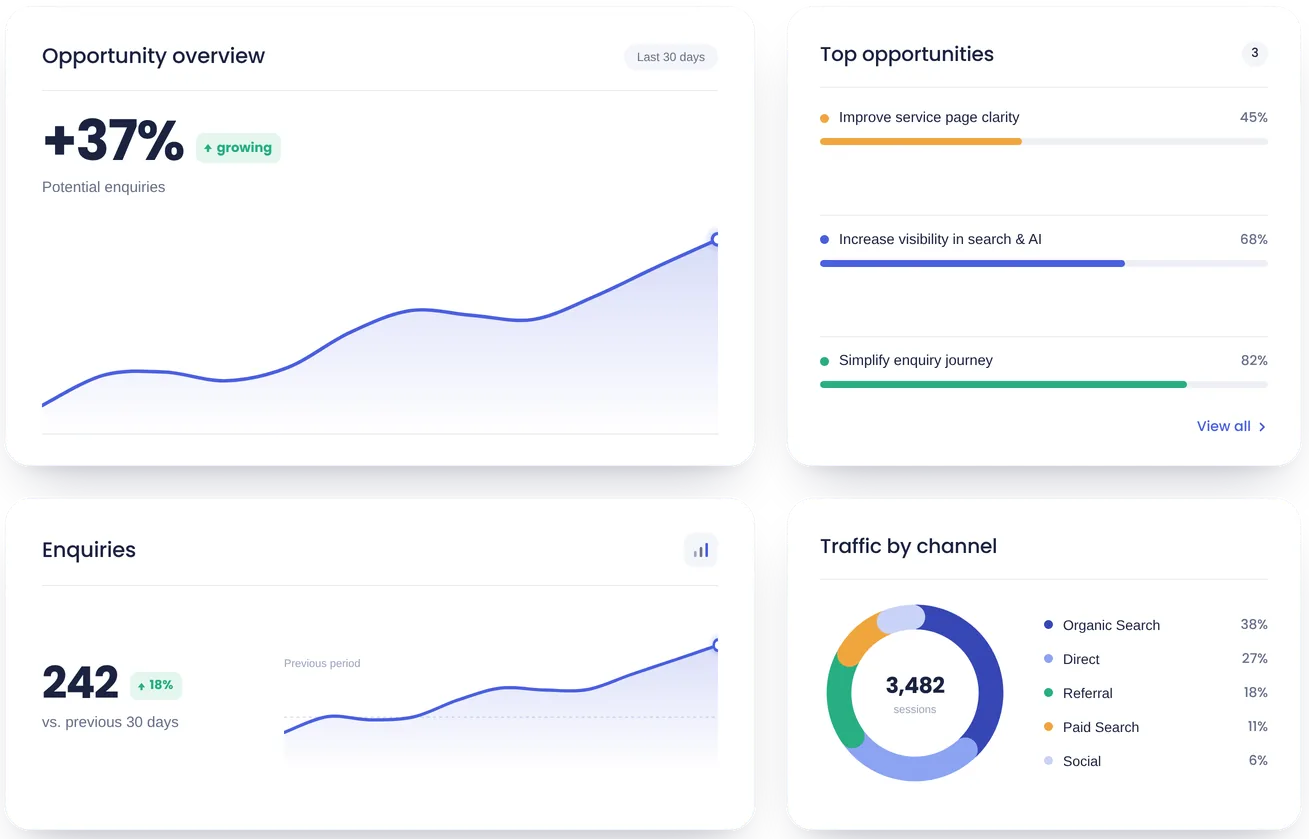
Layered interface cards on a calm background, suggesting a fast, trustworthy digital experience and progression.

Websites

User Experience

Digital Strategy

Credibility

Websites and digital experiences

Maximiliano Chereza

Maximiliano Chereza

3 March 2026

5 min read

Fast, secure digital experiences that reflect your standard, build trust, and give you confident control over your content.

Share

People decide whether to trust you long before a conversation. They do it through what they can see and feel in your digital experiences. That includes your website, client portals, booking flows, dashboards, and any interface that represents you when you are not in the room.

If the experience is slow, confusing, or inconsistent, visitors do not interpret it as a "website issue". They read it as a signal about how the business runs. Even when your delivery is excellent, the screen can quietly introduce doubt.

For ambitious, established businesses, this gap matters. You are not trying to look busy. You are trying to look credible, clear, and worth engaging.


The quiet moments where trust is won or lost

Trust online is built through small, repeated signals. Not grand statements.

A visitor lands on a page. They try to understand what you do. They look for proof. They check if the next step feels safe and straightforward. They decide whether to keep going.

When the experience supports them, it creates a sense of calm. When it fights them, it creates friction and second-guessing.

In practice, trust often breaks in very ordinary places.

  • The navigation makes people work too hard to find what matters
  • Pages take just long enough to feel unreliable
  • The site is hard to scan on mobile
  • The copy is vague, so visitors fill in the gaps themselves
  • Updating content feels risky, so the site stays out of date

None of this means your business is low quality. It simply means your digital presence is not reflecting your standards.


Your website is either an asset or an obstacle

A "brochure site" is not inherently bad. The problem is when your business has grown, but the site has not.

At that point, the website becomes a liability in subtle ways. It slows marketing because updates take too long. It drags sales conversations because prospects arrive with uncertainty. It creates dependency because only one person knows how it works.

A well-structured site does the opposite. It carries part of the trust-building load for you. It answers key questions early, guides people to the right information, and makes the next step feel easy.

This is the shift from online placeholder to business asset.


The real trust signals are practical

Many businesses try to build trust solely through design polish. Design helps, but it is not the foundation.

Trust is created when the experience is well-behaved, quick, and stable, and makes sense on a phone, when content feels current, specific, and consistent.

Think of it as a set of digital trust signals that are more behavioural than visual.

Website performance is one of the clearest examples. Speed changes how people interpret you. A fast site feels prepared. A slow site feels uncertain.

Usability matters in the same way. A user-friendly website is not just "nice to use". It reduces decision fatigue. It helps the right people move forward without needing reassurance.


Structure beats volume

As businesses grow, websites often accumulate. New pages get added. Old pages linger. Navigation expands. Messaging drifts.

Over time, the site becomes a filing cabinet rather than a guided experience.

Structure is what restores clarity.

A good structure helps someone understand, in order:

  1. what you do
  2. who it is for
  3. what outcomes you create
  4. what it is like to work with you
  5. what to do next

When that path is clear, visitors do not need to hunt for confidence. They can feel it.

This is also where a business website starts earning its keep. It becomes a tool that supports conversion, recruitment, partnerships, and reputation, not just a page you maintain.


Control is part of credibility

There is a trust story happening behind the scenes too.

If you cannot update your content safely, the site will fall behind. If every change feels like a risk, you will avoid making improvements. If you are dependent on someone else for basic updates, you lose momentum.

That loss of control has a real business cost. It slows down decision-making and creates hesitation. It can also make the team feel like the website is fragile, which is never where you want to be.

A robust digital setup gives you control over content without making the system messy or complicated. That is part of what "credible" looks like in a modern business.


A quick audit: does your experience build confidence?

You do not need a full rebuild to start seeing what is working and what is not. A calm audit can quickly reveal the biggest trust leaks.

Here are five checks to run this week.

  • Can someone understand what you do in 10 seconds on mobile?
  • Do key pages answer buyer questions without fluff or guessing?
  • Is there grounded proof, like case studies, examples, or testimonials?
  • Do pages load quickly and feel stable across devices?
  • Can you update content safely without relying on one person?

If two or more of these feel shaky, your website is likely underselling you.


What Kurī Studio focuses on when trust matters

Kurī Studio builds fast, reliable, secure websites and interfaces that reflect the standards of your work, build trust, and give you control over your content.

The priority is not trend-driven design. It is clarity, structure, usability, and performance first, with design supporting credibility rather than trying to replace it.

In practical terms, that means shaping the experience around how your business actually operates, and what customers need to understand quickly. It also means simple, safe content management so that the site can evolve without drama.

When those foundations are in place, your digital presence stops being an online brochure. It becomes a strategic asset you can use with confidence as the business grows.


The outcome is fewer doubts and better decisions

A trustworthy digital experience does not just "look nice". It changes the quality of decisions people make about you.

Prospects arrive with more confidence. The right people self-select. Enquiries improve. Your team can move faster because the site supports them rather than requiring constant workarounds.

Most importantly, your online presence feels aligned with the real business. That alignment reduces the quiet stress of knowing your standards are high, while the website tells a different story.

If your business has outgrown its early digital shortcuts, that is not failure. It is simply a signal that the foundation needs to catch up to the stage you are in.


From brochure to business asset

If your website, app, or interface is underselling the standard of your work, we can help you tighten the structure, improve performance, and regain confident control over your content, so it becomes an asset you can rely on as you grow.

Book a short call